
88-Key Semi-Weighted Digital Piano Keyboard with Stand & Bluetooth: In-Depth Review
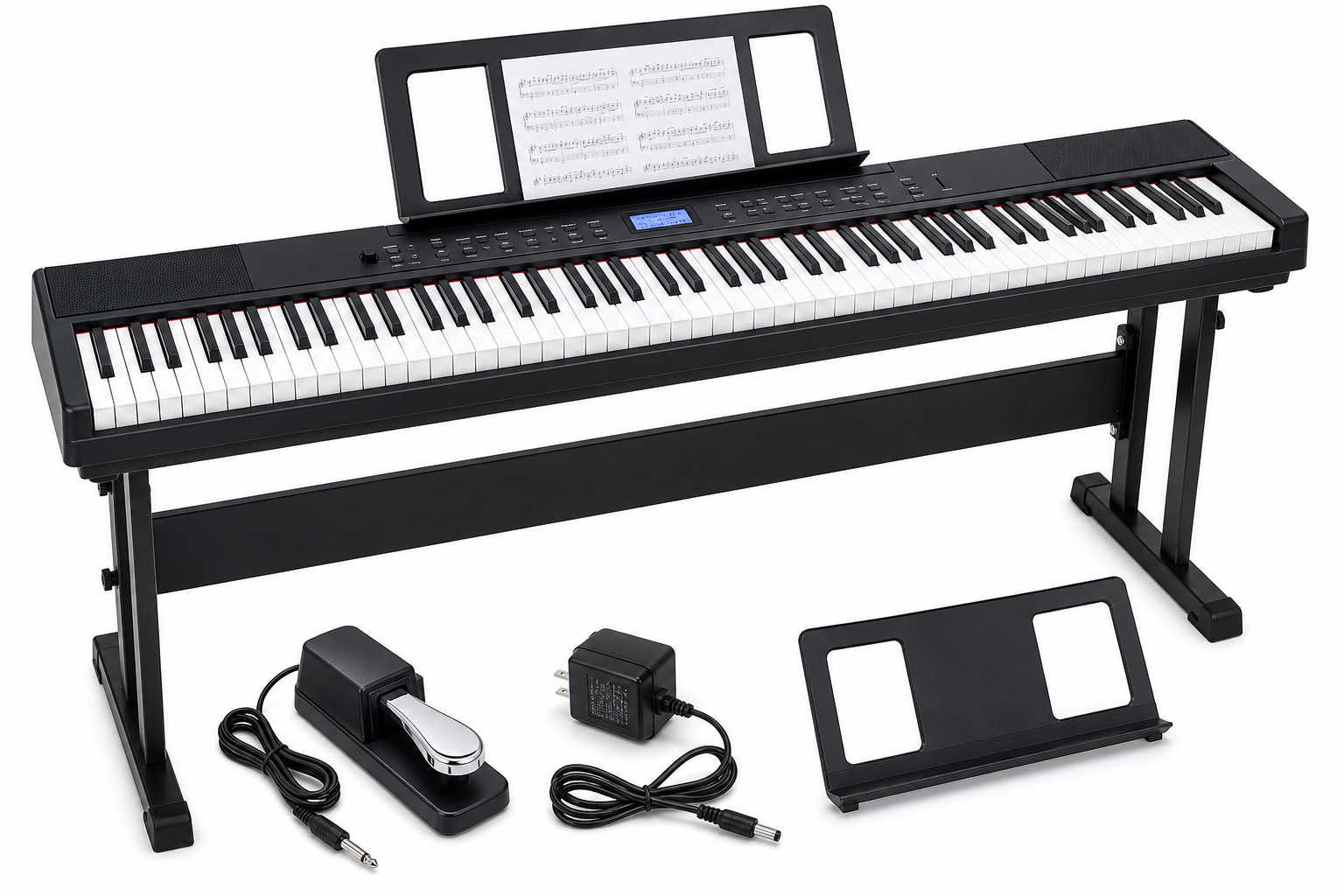
Quick Summary
The 88 Key Piano Keyboard, Semi Weighted Electronic Digital Piano is a full-size instrument aimed at beginners and progressing players who want an affordable, all-in-one setup for home practice and occasional stage use. It combines 88 semi-weighted keys, onboard speakers, Bluetooth audio, MIDI connectivity, and a bundle of accessories (stand, music stand, power supply, and sustain pedal).
At around $89.99 on Amazon, it competes directly with other value-oriented 88-key digital pianos and entry-level stage keyboards. Its central appeal is convenience: you get a complete package that can be set up quickly in a living room, bedroom, or practice corner without needing to buy extra hardware.
Detailed Analysis
Design & Build Quality
This keyboard follows a typical slim digital-piano form factor. The chassis is primarily plastic, keeping weight moderate enough for one person to move it between rooms. While it does not feel as premium or rigid as higher-end wooden-cabinet digital pianos, it is acceptable for the price and intended use.
The included stand is a key part of the package. Depending on the exact variant, you typically get a metal stand designed to support the full 88-key length. It is more stable than placing the keyboard on a regular table, but it’s still a budget stand: fine for normal playing, potentially less confidence-inspiring for heavy-handed players or frequent relocation. Assembly is straightforward, and most users will be able to put it together with basic tools and the included hardware.
The music stand slots into the top of the piano and is sized to hold standard sheet music, method books, or a tablet. This is helpful for students following app-based lessons or online tutorials.
Keybed & Playing Feel
The instrument uses 88 full-size semi-weighted keys. Semi-weighted actions sit between synth-style (very light) and fully weighted hammer actions. Here that translates into:
- Noticeable resistance compared with a cheap toy keyboard.
- Faster and lighter response than a true acoustic-piano-style hammer action.
For beginners, this is usually a good compromise. It encourages proper finger strength and technique more effectively than unweighted keys but remains easy to play for children or adults with no prior experience.
Advanced classical players may find the action too light and not as nuanced in dynamic control (pp to ff) as a hammer-action instrument. For pop, basic jazz, chordal playing, and general practice, however, it performs adequately.
Sound Engine & Speakers
Digital pianos in this category typically provide a core piano sound plus a selection of additional tones (e.g., electric pianos, organs, strings, and pads). While the product listing doesn’t read like a high-end sample library, it’s reasonable to expect:
- A primary acoustic piano voice that is the main workhorse for practice.
- Several alternate piano variations and keyboard sounds for variety.
- Basic layering capability (e.g., piano + strings) on some models.
Built-in speakers are oriented toward near-field listening at home. They are sufficient for personal practice and small rooms, but they won’t compete with dedicated PA speakers or monitors for band rehearsals. At full volume they may sound somewhat compressed or slightly harsh, which is common in this price range.
For stage use or louder environments, using the audio output to connect to an external amplifier or PA system is recommended. This also lets you tailor EQ and volume more precisely.
Connectivity: Bluetooth, MIDI & More
One of the strengths of this keyboard is its connectivity stack, which is designed with modern learning workflows in mind:
- Bluetooth: Allows wireless streaming of audio from a phone or tablet. This is ideal for playing along with YouTube tutorials, backing tracks, or metronome apps without running extra cables.
- MIDI (USB or traditional MIDI, depending on the model): Lets you use the keyboard as a MIDI controller for DAWs, virtual instruments, and learning software. This is valuable if you want to record directly into a computer or explore software pianos.
- Headphone output: Supports silent practice, a crucial feature for apartment living or late-night sessions.
- Aux or line-out (if present): Enables connection to amplifiers, powered speakers, or audio interfaces for recording.
These options position the keyboard as both a practice instrument and a basic studio controller.
Included Accessories
The bundle nature of this product is a major selling point for first-time buyers. Typically, you receive:
- Full-size 88-key semi-weighted digital piano
- Keyboard stand suitable for the instrument’s footprint
- Music stand for books or tablet
- Power supply so you don’t need to rely on batteries
- Sustain pedal for more expressive performance
The sustain pedal is usually a light plastic footswitch rather than a heavy, piano-style unit. It works, but serious players may want to upgrade to a more robust pedal with a traditional feel.
User Experience
Setup & First Use
Out of the box, setup is straightforward:
- Assemble the stand and ensure it’s on level ground.
- Place the keyboard securely on the stand.
- Attach the music stand.
- Plug in the power supply and sustain pedal.
- Turn on and select the main piano voice.
Most users will be playing within minutes. Configuration of Bluetooth pairing and MIDI drivers (on a computer) is slightly more technical but still quite manageable, especially if you follow the included instructions or basic online tutorials.
Learning & Practice
This keyboard is well-suited to common beginner learning paths:
- Traditional lessons with a teacher.
- App-based learning (e.g., via Bluetooth audio and MIDI).
- Self-study with method books and online videos.
The full 88-key range means students will not quickly run into limitations when pieces call for notes at the extremes of the keyboard. Semi-weighted keys, while not as realistic as fully weighted hammers, are close enough to allow meaningful technique development without overwhelming new players.
Portability & Space
The instrument is relatively slim and, combined with the stand, occupies less floor space than a full furniture-style digital piano. It fits well in small apartments, dorm rooms, or bedrooms.
While it is not a lightweight folding keyboard, one person can generally move it room-to-room. For regular gigging, you’d likely want a padded case and a more rugged stand, but for occasional events or home performances it’s serviceable.
Pros
- Full-size 88-key layout suitable for serious practice and long-term learning.
- Semi-weighted action offers a compromise between playability and realistic feel.
- All-in-one package with stand, music stand, sustain pedal, and power supply.
- Bluetooth connectivity for streaming audio from phones or tablets.
- MIDI support makes it useful as a controller for DAWs and virtual instruments.
- Headphone output for quiet practice.
- Relatively compact footprint compared with console-style digital pianos.
Cons
- Semi-weighted keys are lighter and less authentic than fully weighted hammer actions, which advanced players may notice.
- Plastic chassis and budget stand feel less robust than higher-end options.
- Included sustain pedal is functional but basic; some players may prefer to upgrade.
- Built-in speakers are adequate for practice but limited for larger rooms or ensembles.
- Sound engine prioritizes core functionality over high-end realism and extensive editing.
Value Assessment
For buyers prioritizing a complete setup at an accessible price, this 88-key semi-weighted digital piano represents solid value. At approximately $89.99 including stand, pedal, music rest, and power supply, you avoid the incremental costs and compatibility decisions of pairing a separate controller, stand, and accessories.
Learners who plan to take structured lessons, follow app-based courses, or experiment with recording will especially benefit from the combination of Bluetooth and MIDI. The semi-weighted action is sufficient for early to intermediate study and for casual playing, though those set on long-term classical training may eventually want to upgrade to a fully weighted hammer action.
For stage use, it functions as an entry-level solution: fine for small venues or occasional gigs when paired with external amplification, but not designed as a professional touring instrument.
Final Thoughts
The 88 Key Piano Keyboard, Semi Weighted Electronic Digital Piano with Music Stand, Power Supply, Sustain Pedal, Bluetooth, Stand, and MIDI is a practical choice for students and hobbyists who want a full-size keyboard that’s ready to play out of the box. It balances key feel, features, and bundled accessories in a way that should satisfy most beginners and many casual players.
If your top priorities are convenience, modern connectivity, and a full 88-key range at an accessible cost, this model is worth serious consideration. Players who already know they need the most realistic piano action and sound, or who expect heavy gigging, may want to look at higher-tier digital pianos, but for home practice and learning, this instrument delivers a compelling blend of features and value.