
Airbition Talking Flash Cards Review: A Compact Montessori Language Tool for Toddlers
What This Product Is
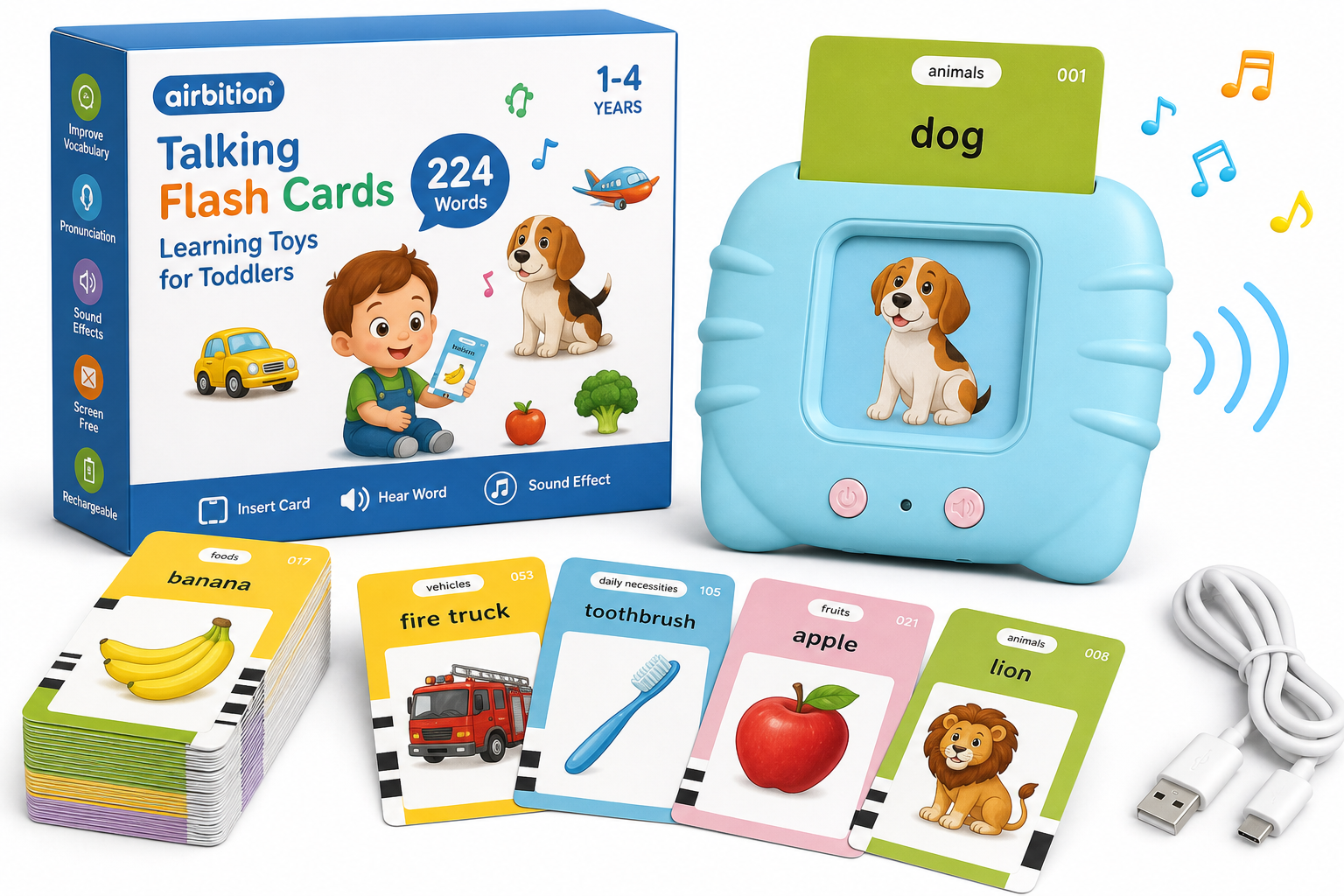
The Airbition Talking Flash Cards for Toddlers Ages 1‑4 (224 Words, English, Blue) is a handheld electronic learning toy designed to support early vocabulary and speech development.
It combines a small battery-powered card reader with a deck of printed flash cards. Each card has a word and illustration; when a card is inserted into the reader, the device speaks the word (and in many cases plays a corresponding sound effect). The set follows a Montessori-style, self-directed learning approach, letting toddlers explore words and sounds independently while still being simple enough for caregivers to guide structured play.
Core characteristics:
- Target age: Roughly 1–4 years
- Language: English word set (224 words)
- Format: Portable electronic reader + thick, printed flash cards
- Use cases: Vocabulary building, pronunciation modeling, pre‑literacy exposure, and simple at‑home speech practice
If you want a single, compact tool that combines flash cards with audio pronunciation and sound effects, this is what Airbition is aiming to provide.
Why It Matters
Early exposure to spoken words, clear pronunciation, and visual word-object associations can meaningfully support language development in toddlers. Tools like the Airbition Talking Flash Cards:
- Reinforce the link between image, word, and sound
- Provide consistent pronunciation every time a card is used
- Encourage independent exploration, which is central to many Montessori-informed approaches
For busy caregivers, the value here is practicality. Instead of relying solely on screens or always having a free hand to read aloud, this device offers:
- A screen‑free option for language practice
- A structured way to introduce and review common nouns, animals, foods, vehicles, and other everyday vocabulary
- A portable activity for car rides, visits, or quiet-time routines
For children who are late talkers or are working on speech with professional support, a simple, repeatable auditory model like this can complement (but not replace) clinical speech therapy and caregiver interaction.
Key Advantages
1. Simple, Toddler-Friendly Operation
The reader is intentionally basic: insert a card, hear the word, and often a sound effect. There are no complicated menus or app pairings. That simplicity matters for toddlers, who benefit from immediate cause-and-effect feedback—they put in a card and something happens right away.
2. 224-Word Vocabulary Across Everyday Themes
With 224 words, the set covers a useful spread of beginner vocabulary categories, such as:
- Common animals and their characteristic sounds
- Everyday objects in the home
- Basic foods and fruits
- Vehicles and outdoor items
This breadth means the product can stay relevant from around age 1 (simple naming and listening) through preschool (sorting, categorizing, and early word recognition games).
3. Audio Feedback for Pronunciation and Engagement
The main differentiator from standard flash cards is audio output:
- The device clearly pronounces the word when the card is inserted.
- Many cards also include a related sound effect (e.g., animal noises, environmental sounds), keeping sessions fun and attention‑grabbing.
This immediate audio feedback supports both receptive language (understanding words) and can gently prompt expressive language (encouraging children to repeat what they hear).
4. Screen‑Free, Montessori‑Aligned Learning
In contrast to apps or videos, this is entirely screen‑free. Children handle physical cards, observe pictures, and listen to audio. That combination aligns well with Montessori and other play-based methods that emphasize:
- Hands‑on interaction
- Real‑world object associations
- Self-paced exploration rather than passive watching
5. Portable and Rechargeable
The reader is compact and designed to fit small hands. According to product details from regional listings, it uses a rechargeable battery with USB charging, and a single charge can power several hours of use. (tiendamia.com.uy)
From a practical perspective, that makes it:
- Easy to pack in a diaper bag or backpack
- Suitable for car rides, waiting rooms, and travel
- Less wasteful than battery-only toys that require frequent replacements
6. Structured but Flexible Play Options
Because each card triggers one word or sound, caregivers can easily vary how they use the deck:
- Simple naming practice for younger toddlers: “This is a cat. Can you find the cat card?”
- Sorting games by category (animals vs. foods, inside vs. outside items)
- Listening and matching: play a word and ask the child to choose the matching picture from several cards
This flexibility helps the toy grow with the child and supports more complex play as attention span increases.
Key Limitations
1. Fixed English Word Set Only
This particular model focuses on English only, with a fixed list of 224 words. Families seeking:
- Bilingual exposure (e.g., English + Spanish), or
- The ability to add custom words
will find this limiting. Airbition offers separate bilingual and larger-vocabulary models, but this specific product does not expand beyond its included cards.
2. Cards Can Be Easy to Misplace
Like any card-based toy, organization depends on the adult. With over 200 cards, it’s easy for them to scatter around the house. The product is more effective long‑term if you:
- Store cards in a labeled box or pouches by theme
- Rotate card sets instead of handing the entire deck to a young toddler at once
Without a routine, cards can get bent, lost, or mixed into other toys.
3. Limited Depth Beyond Single Words
The system is optimized for single-word vocabulary, not sentences or storytelling. That is appropriate for the age range but means:
- It won’t, by itself, teach grammar or conversation
- Children will still rely on caregivers for rich language experiences—reading books, back‑and‑forth conversation, and real‑world naming
Think of this as a supplement to interactive communication, not a comprehensive language program.
4. Audio Variety and Voice Options
While the pronunciation is designed to be clear and child-friendly, the toy relies on a single recorded voice and set of sounds. Some children enjoy repetition; others may tire of the same voice quickly. There are no options to:
- Change the voice
- Adjust sound effects
- Record your own pronunciations
If you’re looking for fully customizable audio, you’ll need a more advanced device.
Who It’s For
The Airbition Talking Flash Cards (224 English words, blue) is well-suited for:
- Toddlers ages 1–4 who are beginning to identify common objects, animals, and foods
- Caregivers who prefer screen‑free learning but still want an engaging, audio-rich toy
- Families using Montessori or play-based learning, who value hands‑on interaction with clear cause-and-effect
- Parents of late talkers (in collaboration with professional guidance), as a tool to repeat and reinforce targeted vocabulary
- Preschool classrooms, daycare, and speech therapy waiting rooms, where children can independently explore cards under supervision
It’s especially appropriate if you want a portable, low-friction way to reinforce everyday vocabulary without relying on a phone or tablet.
Who Should Skip It
This product may not be the best match if:
- You need bilingual or multi-language content. This model is English-only. Consider a bilingual version or a different product if you want equal coverage in two languages.
- You want advanced literacy or phonics instruction. These cards are focused on picture–word pairing and basic sounds, not formal reading instruction or phonics stages.
- Your child is significantly older (5+). Some older preschoolers or early elementary children may find the vocabulary too basic and may benefit more from phonics or sight word sets tailored to beginning readers.
- You dislike managing many small pieces. If you prefer one-piece toys or books, a 224-card set may feel like clutter.
Final Recommendation
The Airbition Talking Flash Cards for Toddlers Ages 1‑4, 224 English Words, Blue is a thoughtful blend of audio learning, tactile interaction, and visual cues packaged in a compact, child-friendly device. It doesn’t replace caregiver interaction or professional speech therapy, but it does provide a convenient, screen‑free way to:
- Introduce and reinforce a wide range of everyday words
- Encourage toddlers to explore cause and effect through card insertion
- Support early listening and pronunciation practice in a playful format
If your primary goal is to build early English vocabulary for a toddler using a simple, portable, and engaging tool, this Airbition set is a strong, practical option. Caregivers who intentionally structure play, rotate cards, and combine the toy with real-world conversation and reading will get the most long‑term value from it.