
Elikliv EDM4 4.3-Inch LCD Digital Coin Microscope Review: A Practical Entry into Digital Magnification
Introduction
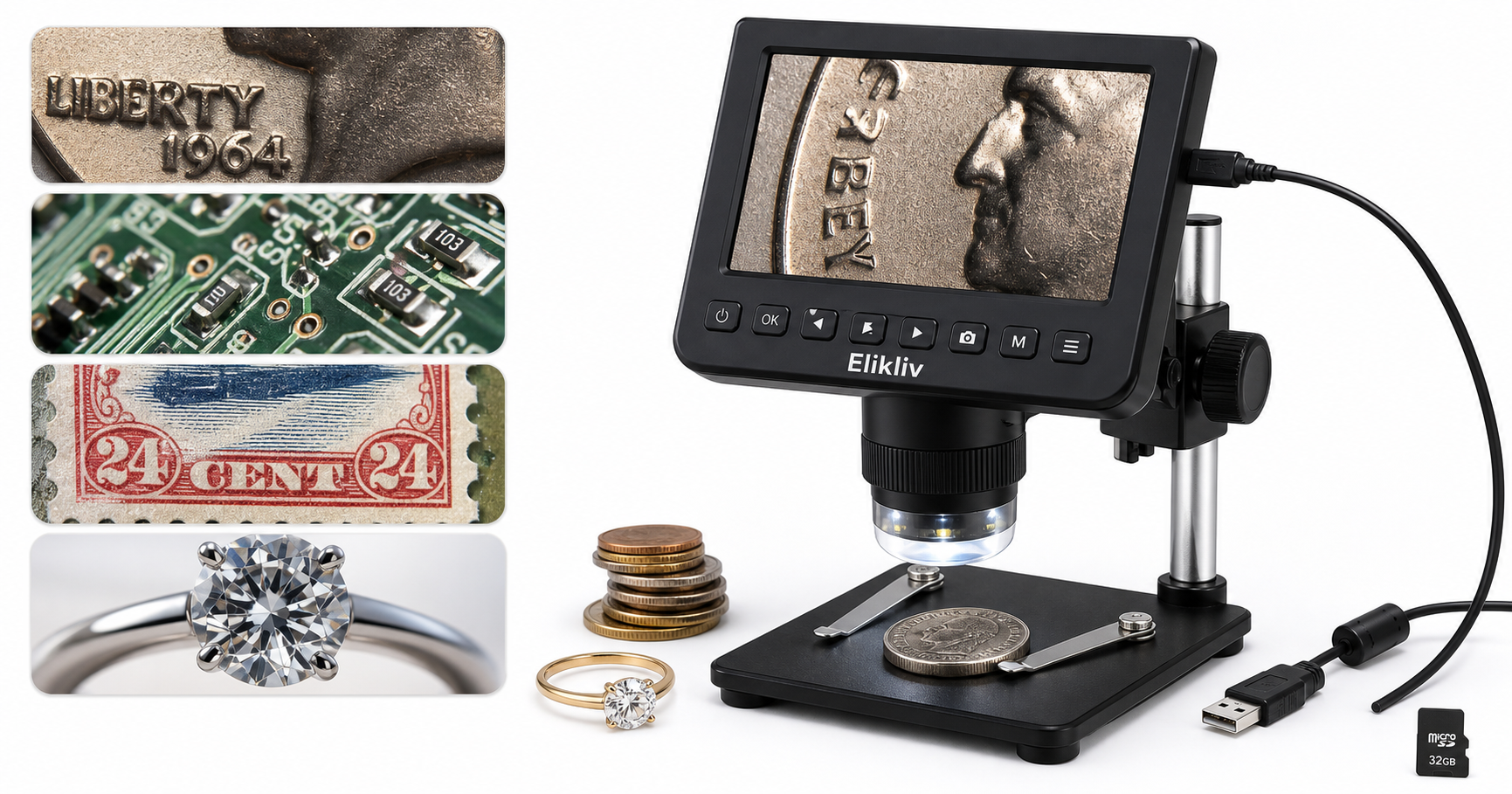
The Elikliv Microscope, LCD Digital Coin Microscope 1000x, EDM4, 4.3-Inch is designed for users who want more detail and documentation capability than a handheld loupe, without stepping up to a full laboratory or stereo microscope. It combines a 4.3-inch LCD screen, a claimed 50–1000x magnification range, 8 adjustable LED lights around the lens, and the ability to capture photos and videos to a microSD/TF card or view on a PC.
It’s marketed primarily as a coin magnifier, but its feature set makes it equally useful for electronics inspection (e.g., solder joints, PCB traces), jewelry, stamps, and general hobby work. At around $35.89 on Amazon, it targets the entry-level segment where ease of use and convenience matter as much as absolute optical quality.
Setup / Getting Started
Out of the box, the Elikliv EDM4 typically includes:
- The microscope unit with 4.3-inch LCD
- Metal/aluminum base and adjustable stand
- USB cable for power and PC connection
- User manual
Assembly
Assembly is straightforward and should take only a few minutes:
- Attach the column to the base – The column fastens to the metal base with a screw, providing a stable platform.
- Mount the microscope – The microscope body clamps onto the stand’s bracket. Height can be adjusted by sliding the bracket up or down.
- Connect power – Plug the USB cable into the microscope and either a USB power adapter or a PC USB port.
- Insert a TF/microSD card (optional) – If you plan to capture images and videos directly on the device, insert a compatible card before powering on.
First Power-On and Configuration
On first startup, the 4.3" LCD displays a live image. From here you can:
- Adjust focus manually by rotating the focus knob on the lens barrel.
- Use the height adjustment on the stand to change the working distance and effective magnification.
- Turn the LED brightness dial to increase or decrease the intensity of the eight surrounding LEDs, which is crucial for reflective surfaces like coins.
- Explore menu options via the onboard buttons to set image resolution, video resolution, time stamp, and storage preferences.
PC connectivity is provided via USB. On compatible Windows systems, the microscope can appear as a standard USB camera, allowing you to use common webcam or capture software. Some listings and documentation mention Mac compatibility; in practice, support may depend on the specific revision of the product and the software you use, so Mac users should verify before relying on it.
Daily Usage
Ergonomics and Handling
The integrated 4.3-inch LCD is one of the main advantages over traditional optical microscopes or simple USB cameras. You can:
- View without hunching over eyepieces.
- Share the view with others easily.
- Quickly reposition objects while watching the screen.
The stand is compact, which helps on a crowded desk, but the working area under the lens is somewhat limited. For coins, small circuit boards, and jewelry pieces, the space is usually sufficient; larger or oddly shaped objects may be trickier to position.
For Coin Collectors
For its intended use as a coin microscope, the EDM4 handles:
- Date, mint mark, and small inscription checks with ease.
- Die cracks, doubling, and surface defects at moderate to high magnification, especially with careful lighting.
- Quick side-by-side comparisons (by swapping coins) since the device powers up quickly and has persistent camera settings.
Reflections on shiny or proof-finish coins can be challenging. Adjusting LED brightness and slightly changing the viewing angle usually mitigates glare, but there is no built-in polarizing filter or ring diffuser, so some trial and error is required for ideal illumination.
For Electronics, Soldering, and Hobby Work
For electronics hobbyists, the EDM4 is useful for:
- Inspecting solder joints, traces, and SMD components after reflow or hand soldering.
- Checking for bridged pins or cracked traces.
- Documenting board issues or modifications with still photos.
Using it as a live view aid while soldering is possible but not as comfortable as with larger-screen or articulated-arm digital microscopes. Depth perception is limited (as with most 2D digital microscopes), and the stand’s height and working distance mean you may need to position the iron carefully to avoid hitting the lens.
For Stamps, Jewelry, and Other Collectibles
The microscope’s magnification range and built-in lighting work reasonably well for:
- Inspecting stamp perforations, overprints, and paper texture.
- Examining stone settings, prongs, and hallmarks in jewelry.
- Looking at tool marks, small mechanisms, or fine print on other collectibles.
The 4.3-inch screen isn’t large enough for group viewing at a distance, but up close it provides more than enough detail for single-user inspection.
Performance & Reliability
Image Quality and Magnification
The EDM4 offers a claimed 50X–1000X magnification range (dependent on screen size and working distance). In practice:
- At lower magnifications, it provides a broad field of view suitable for seeing an entire coin or larger area of a PCB.
- At higher magnifications, you can resolve fine details like surface grain, micro-scratches, or tiny solder bridges.
Image resolution is typically 720p on the LCD and in captured photos/videos. For most hobby use—particularly coin inspection and documentation—this resolution is sufficient, though it is not on par with more expensive 1080p or 4K digital microscopes.
Color reproduction is generally accurate but slightly cool, and sharpness is best in the center of the frame. Edges can soften somewhat at higher magnifications. For inspection and identification, this is acceptable; for high-end photography or publication, users may find the image quality limiting.
Lighting
The 8 adjustable LEDs around the lens are bright enough for most indoor use. Advantages include:
- Even, close-range illumination for flat objects.
- Adjustable brightness to reduce glare on reflective surfaces.
However, because the light source is close to the lens, highly reflective items like polished coins or jewelry can produce hotspots. Tilting the object or reducing brightness usually helps.
Controls and Software
On-device buttons handle:
- Power and menu navigation
- Snapshot capture
- Video recording
Menu navigation is basic but functional. Icons and text may appear small on the 4.3-inch display, but after a short learning curve, most users can adjust settings quickly.
On a PC, the microscope behaves like a standard USB camera. Using common video capture or webcam software, you can:
- Capture higher-volume photo sets.
- View on a larger monitor for easier, more relaxed inspection.
- Share your screen during remote sessions or documentation work.
Reliability and Build Quality
The EDM4 uses a metal base and column that provide better stability than purely plastic stands in the same price range. The microscope body is plastic but reasonably solid for light-duty use.
User feedback and long-term reports suggest:
- The device performs reliably for typical hobby usage.
- Buttons and focus mechanism hold up reasonably over time if not over-tightened or forced.
- The stand’s joints can loosen gradually with frequent adjustments, but this can typically be corrected by tightening screws.
There is no sealed optical path, so in dusty environments, some care is recommended to avoid debris on the lens.
What Works Well
- Integrated 4.3-inch LCD: Eliminates the need for a separate monitor or laptop for basic inspection and makes the unit very approachable for beginners.
- Versatile magnification (50–1000x): Covers coin examination, electronics, and a variety of hobby applications.
- Adjustable 8-LED lighting: Provides sufficient illumination for most use cases and enables work in dimly lit areas.
- Photo and video capture: Handy for documenting finds, sharing with other collectors, or tracking work on electronics repairs.
- PC connectivity: Viewing on a larger screen makes extended sessions more comfortable and enables remote sharing and recording.
- Compact footprint: Fits on a small desk or workbench without requiring permanent dedicated space.
- Value for money: At approximately $35.89, it sits in a price bracket where features like an LCD and metal base are not always guaranteed.
What Could Be Improved
- Screen size and resolution: While usable, the 4.3-inch 720p display is small by modern standards. A larger or higher-resolution screen would improve comfort and clarity, especially for fine electronics work.
- Limited working distance: At higher magnifications, there is limited space between lens and subject. This is typical of this class of microscope but still worth noting if you plan to work under the lens with tools.
- Glare on reflective surfaces: The close, ring-style LED lighting can create hotspots on shiny coins and jewelry. A diffuser or optional lighting accessories would improve image consistency.
- Depth perception: Like most digital microscopes that display on a flat screen, there is no true stereoscopic view. Tasks that require fine depth judgment can feel less natural than under a stereo optical microscope.
- Software and OS clarity: Documentation and product listings sometimes differ on Mac compatibility. Clearer, unified information and dedicated software would help users plan their setup.
- Stand flexibility: The included stand is adequate but not highly adjustable in terms of angle and reach. Users doing more complex work might eventually want a more flexible mounting solution.
Overall Impression
The Elikliv EDM4 4.3-Inch LCD Digital Coin Microscope offers a solid mix of features for hobbyists, coin collectors, and electronics tinkerers who want more capability than a simple loupe or bare USB camera, without investing in an expensive lab-grade system.
Its strengths lie in the convenience of an integrated screen, adjustable LED lighting, and simple photo/video capture, all on a compact metal-based stand. Image quality and ergonomics are good for the price bracket, though users seeking professional-level imaging or extended soldering comfort may eventually look to higher-end options.
For many users, particularly those getting started with coin collecting, stamp inspection, or small-scale electronics work, the Elikliv EDM4 represents a practical and budget-conscious step into digital microscopy. If your expectations are aligned with its entry-level price point of about $35.89 and you value convenience and versatility over absolute optical performance, it is a compelling option to consider.