
Kinsa QuickCare Smart Thermometer Review: A Connected Fever Thermometer for the Whole Family
What This Product Is
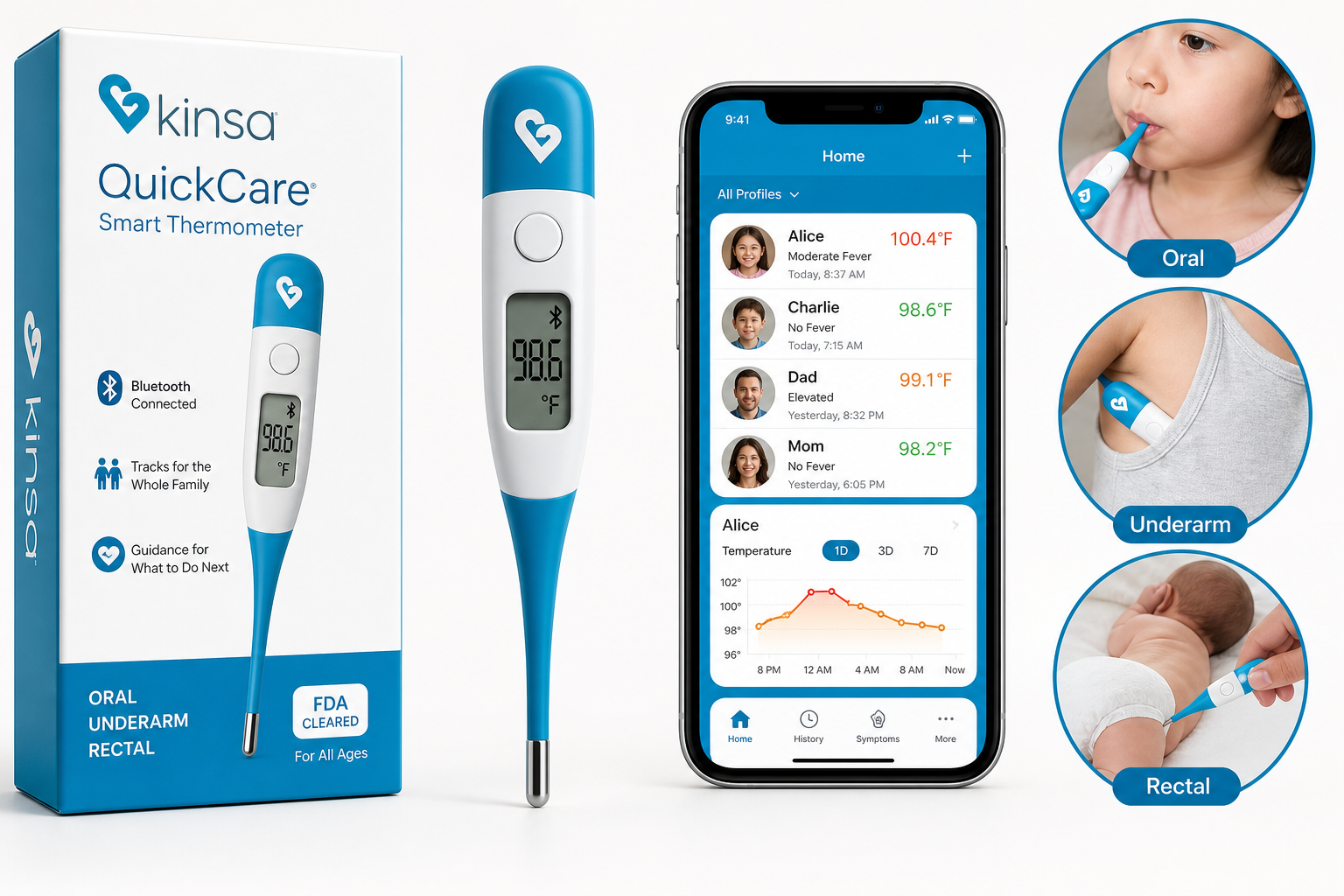
The Kinsa QuickCare Smart Thermometer (model referenced by the Amazon listing B0795ZW85G) is a Bluetooth digital thermometer designed for oral, underarm (armpit), or rectal temperature readings. It’s FDA-cleared as a medical device and intended for use across all ages—babies, kids, and adults.
Unlike a basic digital thermometer, QuickCare pairs with the Kinsa app on a compatible iOS or Android smartphone via Bluetooth. Once connected, the app can automatically log readings, associate them with individual family members, track symptoms over time, and offer guidance on what to do next based on age, temperature, and reported symptoms.
Physically, it’s a slim stick-style thermometer with a flexible tip, a small display, and a single button. It’s water-resistant enough for standard cleaning and disinfection of the probe area. The device can be used both with and without the app; when used without the app, the reading appears directly on the built-in display, but you lose automatic logging and app-based advice.
From a positioning standpoint, this model sits between low-cost, no-frills digital thermometers and higher-priced infrared ear or non-contact forehead thermometers. On its Amazon product page, it’s generally positioned as an accessible smart thermometer at around $18.94, which is competitive with other connected fever thermometers.
Why It Matters
Most households still rely on conventional digital thermometers that simply show a number and nothing more. The Kinsa QuickCare aims to solve several practical problems that come up in real-life fever management:
- Tracking fevers over time – Especially with kids, it’s easy to forget exact readings, times, and which child had which temperature. The Kinsa app automatically logs each reading and lets you see trends over hours or days.
- Age-specific guidance – A "high" temperature can mean different things for a 3‑month‑old baby versus a 10‑year‑old child. The app adjusts its guidance based on age and reading method (oral, underarm, or rectal).
- Family management – In multi-person households, you can assign readings to specific profiles, helping you keep track of who is sick, how long they’ve had a fever, and how they’re progressing.
- Better context for a single number – The thermometer itself delivers a fast, accurate reading, but the app gives that number context—whether it’s likely mild, moderate, or more concerning based on medical guidelines and age.
For parents, caregivers, and anyone who wants more than a single static reading, QuickCare’s connected features can make illness management more organized and less stressful.
Key Advantages
1. Versatile Measurement Methods (Oral, Underarm, Rectal)
QuickCare supports three common measurement sites:
- Oral – Suitable for older children and adults; offers a good balance of convenience and accuracy.
- Underarm (armpit) – Easier for young children or restless patients; typically slightly less precise than oral or rectal but still clinically useful when technique is correct.
- Rectal – Considered the most accurate method for infants, especially under 6 months, and recommended when precise readings are crucial.
Being able to use a single device in all three modes makes this thermometer flexible enough for different ages and comfort levels. Families with both infants and older kids can use one model (with strict separation of any thermometer designated for rectal use).
2. Fast, Digital Readings with Clear Display
The QuickCare provides rapid readings, typically in well under a minute, and displays them on its built-in screen. Compared to older glass or slower digital thermometers, this helps reduce the time you need to keep a child still, which is especially valuable when dealing with toddlers or babies who resist temperature checks.
The display is compact but readable, showing the temperature and basic icons indicating connection or mode. For many use cases, you can rely entirely on the device display without pulling out your phone.
3. Bluetooth Connectivity and Smart App Features
Paired with the Kinsa app, QuickCare unlocks a set of software features not available in standard digital thermometers:
- Automatic logging of readings with timestamps
- Profiles for multiple family members, so each reading is assigned to the right person
- Symptom tracking, allowing you to record cough, congestion, chills, and other indicators alongside temperature
- Personalized guidance based on age, reading site, and temperature range, providing general advice on monitoring vs. seeking care
- Trend visualization, showing how fever patterns change over time
These app features are particularly useful during multi-day illnesses, such as flu or prolonged viral infections, where tracking the progression of fever helps inform conversations with healthcare providers.
4. Works with or Without the App
Although the QuickCare is marketed as a smart thermometer, you can still use it as a standard digital thermometer without connecting it to a smartphone. In that mode, it functions much like any typical digital oral/underarm/rectal thermometer:
- Press the button
- Place the probe appropriately
- Wait for the beep
- Read the temperature from the display
This dual capability is important in households where not everyone wants to use the app or when a phone isn’t nearby.
5. FDA-Cleared and Designed as a Medical Device
The thermometer is FDA-cleared, which means it meets regulatory requirements for safety and performance for its intended use. For medical products, this is important reassurance: it isn’t a generic gadget, but a device that has passed relevant clearance processes for clinical-grade accuracy claims.
6. Suitable for Babies, Kids, and Adults
Because the device is safe for oral, underarm, and rectal use, it’s suitable from infancy through adulthood. For infants, especially those younger than 6 months, rectal readings provide the most reliable data for clinical decisions. For older kids and adults, oral measurements are typically sufficient and more comfortable.
Households only need to become familiar with one device and a consistent set of instructions, which can reduce confusion compared with juggling multiple thermometer types.
Key Limitations
1. Reliance on a Smartphone for Full Value
While QuickCare does function without the app, many of its signature benefits—automatic logging, trend visualization, and context-aware guidance—require a compatible smartphone and the Kinsa app.
Potential downsides:
- You’ll need to download and install the app, then create or log into an account.
- Compatibility is limited to specific versions of iOS and Android with Bluetooth support; very old phones, tablets, or alternative platforms (like Windows phones or desktop computers) generally aren’t supported.
- If you prefer not to use a smartphone at all, you’re paying for smart capabilities that you won’t fully use.
2. App Setup and Permissions
Because QuickCare is a connected medical product, the app may request permissions (such as Bluetooth and, in some cases, location or notification access). For privacy-conscious users, creating an account and granting permissions may feel like unnecessary friction compared with simple standalone thermometers.
Some users also report that setup can occasionally be confusing if the Bluetooth pairing sequence isn’t followed exactly or if multiple devices are nearby.
3. Battery and Maintenance Considerations
QuickCare runs on a user-replaceable battery (typically a coin cell). Over time, you’ll need to replace the battery to keep the thermometer functioning. Although battery life is generally long under normal use, heavy use or long-term storage can still lead to eventual replacement.
As with any digital thermometer, you’ll also need to:
- Clean and disinfect the probe correctly after each use
- Avoid submerging the entire device in water
- Store it carefully to protect the sensor and tip
4. Not a Non-Contact or Ear Thermometer
Despite the "smart" label, QuickCare is still a contact thermometer, meaning it must touch the body (oral, underarm, or rectal). Users looking specifically for non-contact forehead or in-ear infrared measurements may find this less convenient in certain scenarios, such as taking a quick reading on a sleeping child without waking them.
If you strongly prefer non-contact measurement, a different thermometer form factor (like a forehead or ear model) may be a better match, even though QuickCare is often more affordable than many of those options.
Who It’s For
The Kinsa QuickCare Smart Thermometer is a good fit for:
-
Families with infants and young children
- Rectal-reading capability supports accurate temperature checks in very young infants.
- Multiple measurement options make it easier to transition from rectal (for infants) to oral or underarm as children age.
- The app’s age-based guidance can help new parents interpret readings and decide when to call a pediatrician.
-
Households that value health tracking and data
- If you like logging health data, tracking trends, and having a record of fevers and symptoms, QuickCare’s app integration is compelling.
- The ability to show a timeline of readings and symptoms to a healthcare provider can be helpful during telehealth visits or in-person appointments.
-
Tech-comfortable users who don’t mind smartphone setup
- Users who are used to installing apps, creating accounts, and pairing Bluetooth devices will likely find QuickCare straightforward.
- If you already use fitness trackers or other connected health devices, adding a smart thermometer to your ecosystem is a natural next step.
-
Caregivers for multiple people
- Parents, guardians, or caregivers of several children—or mixed households with children and seniors—benefit from separate profiles and centralized logs for each person.
-
Budget-conscious buyers wanting smart features
- Priced around $18.94 on its product page, QuickCare often undercuts more expensive infrared forehead and ear thermometers while still delivering smart connectivity.
Who Should Skip It
You may want to look at other thermometers if:
-
You dislike using smartphones for medical devices
- If you don’t own a compatible smartphone or strongly prefer not to install health apps or create accounts, a simpler digital thermometer may provide better value.
-
You specifically want non-contact or ear-only readings
- For users who prioritize the convenience and speed of non-contact forehead or dedicated ear thermometers—especially for taking readings on sleeping children—a contact stick thermometer like QuickCare may not meet expectations, even if it’s accurate.
-
You need full compatibility with older or uncommon devices
- Households with very old smartphones, unsupported operating systems, or non-standard platforms may not be able to use the app. In that case, a purely standalone thermometer might be simpler.
-
You prefer absolute simplicity and the lowest possible cost
- If your priority is just a basic, functional thermometer with no connected features at the lowest possible price, you can likely find non-smart digital models that are cheaper than a smart, connected option.
Final Recommendation
The Kinsa QuickCare Smart Thermometer combines a proven, FDA-cleared digital thermometer with a thoughtfully designed smartphone app that adds real-world value: better tracking, clearer context for readings, and family-friendly management. Its support for oral, underarm, and rectal use makes it adaptable from infancy through adulthood, and the option to use it with or without the app offers flexibility.
However, the product’s biggest strengths—logging, symptom tracking, and personalized guidance—depend on your willingness to install and use the accompanying app. If you’re comfortable with a smartphone-based workflow and want more insight than a traditional thermometer provides, QuickCare is a strong choice at around $18.94. Families with infants or multiple children, and anyone who appreciates detailed health logs, are likely to get the most benefit.
If you prefer non-contact measurement, want to avoid apps entirely, or need the absolute lowest-cost option, a different thermometer type will likely suit you better. But for many modern households, especially those that already track health data digitally, the Kinsa QuickCare offers a well-balanced mix of accuracy, versatility, and smart features in a compact, everyday thermometer.