
LeapFrog Learning Friends 100 Words Book Review: An Interactive First Vocabulary Library
Introduction
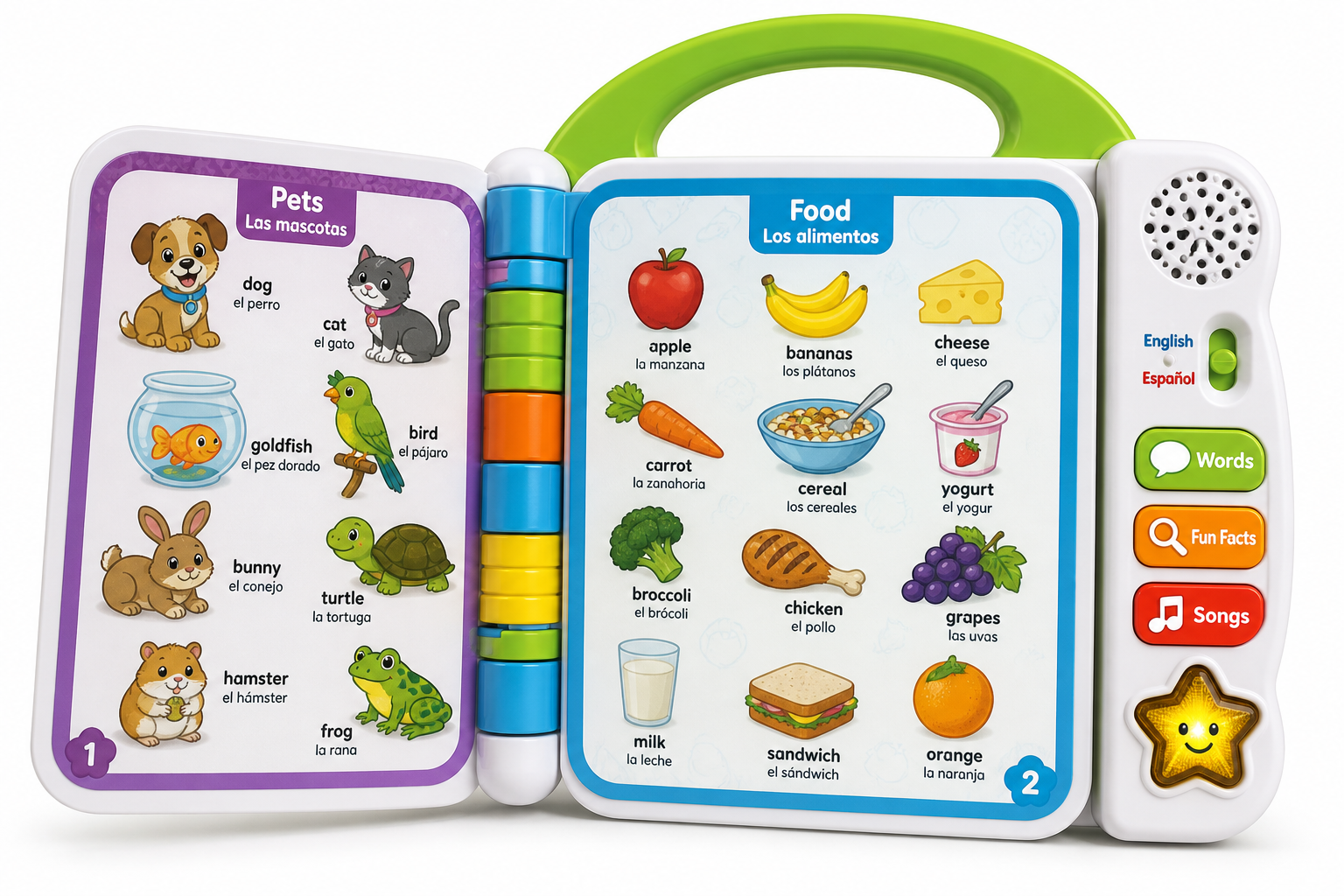
The LeapFrog Learning Friends 100 Words Book is an interactive, bilingual vocabulary book aimed at toddlers who are beginning to explore language. Rather than being a traditional picture book, it combines sturdy pages with touch‑sensitive technology, friendly animal characters and multiple audio modes to introduce everyday words in a playful, repeatable way.
For parents and caregivers looking for a screen‑free learning toy that still feels modern and engaging, this book sits at the intersection of classic board books and electronic learning devices.
Product overview and key features
At its core, the LeapFrog Learning Friends 100 Words Book is designed to build early vocabulary in context, using familiar categories and simple interactions.
Design and build
- Book‑style format with carry handle – The device opens like a hardback book and includes a built‑in handle on the spine, sized for small hands.
- Durable, wipe‑clean pages – Thick, plasticized pages are built to withstand heavy toddler use and can be wiped down with a damp cloth.
- Large, colorful illustrations – Each page is filled with bright images and clear word labels, making it easy for children to associate pictures with spoken words.
Vocabulary and categories
LeapFrog’s learning team selected over 100 age‑appropriate words, grouped into everyday themes such as:
- Pets and other animals
- Food and mealtime
- Colors
- Activities
- Opposites
- Outdoor and nature themes
Organizing words by category helps young children notice relationships between concepts (for example, different kinds of animals or contrasting pairs like big/small).
Bilingual learning (English and Spanish)
A key selling point is its full bilingual experience:
- A language switch allows you to toggle between English and Spanish.
- Words, sound prompts and songs are available in both languages.
- Children can hear the same picture labeled in two languages, supporting early exposure to bilingual vocabulary.
Interactive learning modes
The right‑hand control panel includes mode buttons that change how the pages respond to touch:
-
Words Mode
- Touch a picture to hear the corresponding word spoken aloud.
- Ideal for first exposure and repetition.
-
Fun Facts / Sounds Mode
- Touch a picture to hear either a short fact or a related sound effect (for example, an animal noise).
- Adds context and keeps repeated play interesting.
-
Songs Mode (via star button)
- Press the light‑up star button to trigger learning songs, including a theme song and a playful “favorite words” song.
- The songs reinforce vocabulary while providing a break from straight drilling.
The toy also includes an auto‑off function after a short period of inactivity, helping conserve battery life.
Performance and user experience
Learning value and engagement
For toddlers, the combination of touch + sound + visual cues makes the learning process intuitive:
- Children simply tap a picture to hear the word, with no complex interface to learn.
- Repetition is natural; many kids will return to the same pages and images multiple times.
- The move from simple word playback to fun facts and sounds allows the toy to grow with the child, adding interest beyond the initial novelty.
Because the content spans common categories like animals, foods and everyday objects, parents can reinforce learning in real life (e.g., pointing out foods at mealtime that match words from the book).
Bilingual experience in daily use
The bilingual aspect can be valuable in several scenarios:
- Bilingual households can use it to reinforce vocabulary in both home languages.
- Monolingual English families can use the Spanish mode for early exposure to a second language in a low‑pressure way.
Switching languages is done with a physical slider, so adults can control when the child hears English or Spanish. Many families report alternating between languages to keep the content fresh.
Ease of use and ergonomics
- Simple controls make it accessible even for toddlers around 18–24 months with some guidance.
- The handle and compact footprint make it easy to bring on trips or car rides.
- Touch sensitivity is generally forgiving; children do not need to tap precisely to trigger audio, though very light touches may occasionally miss.
The main consideration is audio repetition: enthusiastic toddlers may repeatedly press the same image or the star button, which some adults will find noisy over time.
Durability and maintenance
- The robust plastic shell and thick pages are well‑suited to rough handling.
- The surfaces can be cleaned with a slightly damp cloth (immersion in water is not recommended).
- Batteries are replaceable via a secured compartment, so the toy can stay in rotation for years with basic care.
Overall, the build quality is solid for an electronic toddler toy, and the auto‑off feature helps avoid unnecessary battery drain.
Pros and cons
Pros
- Over 100 age‑appropriate words organized into meaningful everyday categories.
- Bilingual English/Spanish audio for words, prompts and songs.
- Three learning modes (words, fun facts/sounds, songs) support progression and reduce monotony.
- Sturdy, easy‑to‑clean construction designed for toddler use.
- Intuitive tap‑to‑hear interaction that even very young children can grasp.
- Portable, screen‑free learning tool suitable for travel and quiet time.
Cons
- Audio repetition can be loud or tiring for adults, especially when children fixate on the star song button.
- Limited vocabulary set (100 words) means older preschoolers may outgrow the content relatively quickly.
- Focus on single words rather than sentences, so it complements but does not replace storybooks and conversational learning.
- Requires batteries, and performance depends on keeping them fresh.
Conclusion and recommendation
The LeapFrog Learning Friends 100 Words Book is a thoughtfully designed first‑vocabulary toy that balances simplicity with meaningful educational value. Its touch‑sensitive pages, friendly characters and bilingual audio create an inviting environment for toddlers to explore words at their own pace.
It works best as a supplement to, not a replacement for, shared reading and everyday conversation. Within that role, it excels: children can independently practice words they encounter in real life, and parents can easily weave book content into daily routines.
For families seeking a durable, screen‑free, bilingual vocabulary tool for toddlers, this book is a strong candidate and is likely to see frequent use, especially in the 1–3‑year age range. The combination of robust construction, clear voice prompts and simple operation makes it a practical, engaging addition to an early‑learning toy collection.