
Newlam Kalimba Thumb Piano 17 Keys Review: A Beginner-Friendly Entry into the World of Thumb Pianos
Introduction
The Newlam Kalimba Thumb Piano 17 Keys, Musical Gift for Kids and Adults is a compact wooden thumb piano (model CA-17B) designed to make the kalimba approachable for first-time players. With 17 ore-steel keys mounted on an air-dried wooden body, it aims to balance portability, tone quality, and beginner-friendly design.
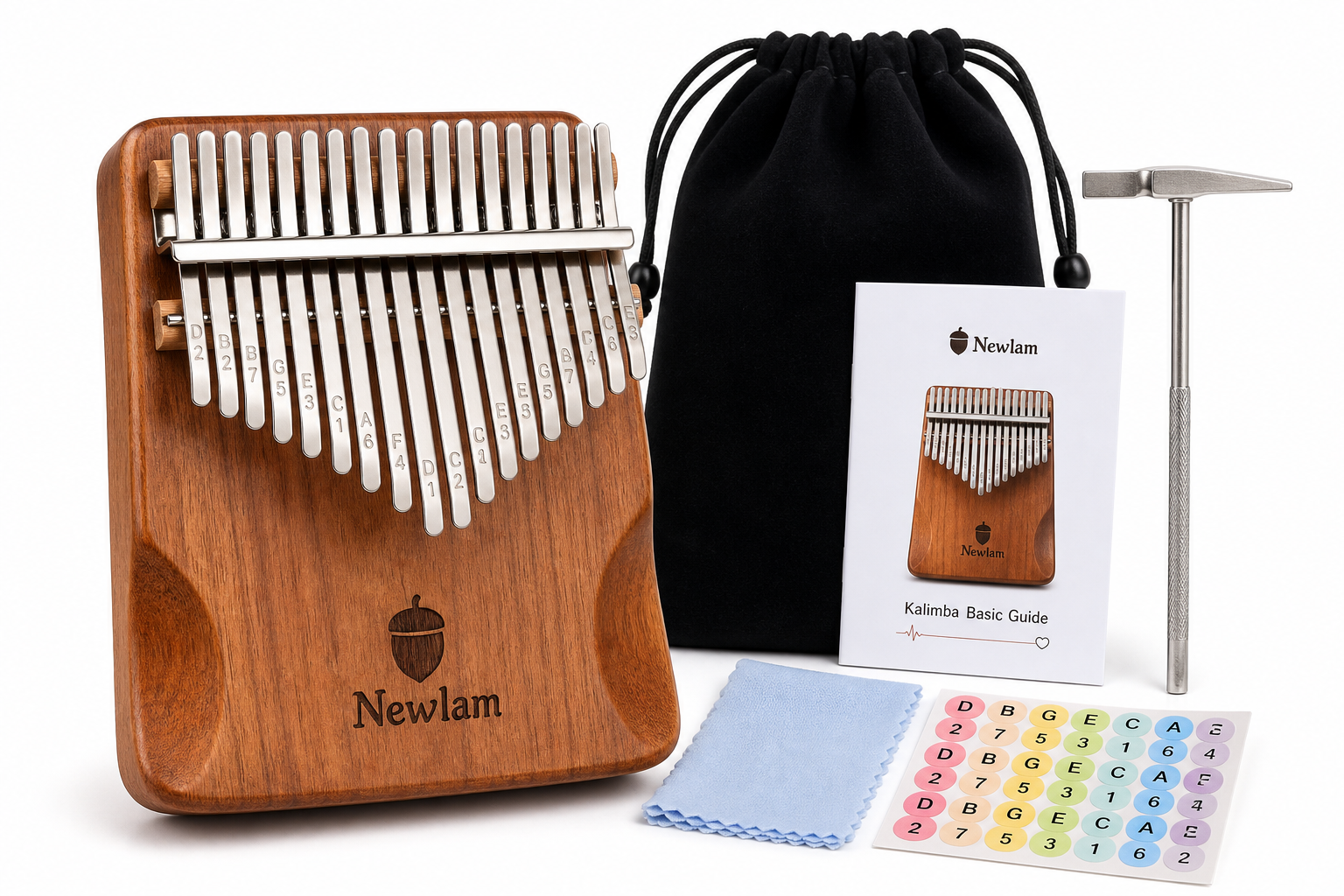
Shipped as a small kit—typically including the kalimba, a tuning hammer, soft bag, cleaning cloth, stickers, and a short guide—the Newlam targets learners who want to start playing simple melodies within minutes rather than investing heavily in a more advanced instrument.
From a value standpoint, it sits in the common beginner-kalimba price band around $25.99, which places it squarely in competition with other entry-level 17-key thumb pianos aimed at casual players and gift buyers.
Typical Use Cases
-
First instrument for beginners
Many buyers are completely new to kalimba and often to instruments in general. The 17-key C-major layout and included guide are intended to help users play recognizable tunes quickly. -
Relaxation and casual playing
The soft, bell-like tone and relatively low volume suit quiet practice sessions, evening relaxation, or background music without disturbing others. -
Gift for kids and teens
The small form factor and simple playing technique make it accessible for children, while the wooden finish appeals to older beginners and adult hobbyists. -
Portable music on the go
At around 7 × 5 × 1.2 inches and roughly 0.7 lb, the instrument fits easily in a backpack or bag, and the included soft case supports basic protection during travel. -
Light recording and social media clips
With reasonably clear tone and sustain for its price tier, the kalimba is suitable for simple recordings on a phone or laptop for social media posts, practice logs, or personal composition sketches.
Performance in Each Scenario
1. First Instrument for Beginners
For beginners, the Newlam performs well in several key areas:
- Learning curve: The C-major tuning on 17 keys matches the majority of beginner tutorials and tabs available online. The included guide and stickers help new players associate each tine with its corresponding note and letter name.
- Embossed key labels: The note names are stamped directly into the metal keys, reducing reliance on stickers that can wear off or be misaligned over time. This is especially helpful for children or adults unfamiliar with music notation.
- Out-of-the-box tuning: Units are advertised as pre-tuned. In practice, they often arrive close to pitch but can require minor adjustments using the included hammer. This is normal for instruments in this price range but means a tuning app and a few extra minutes of setup are advisable.
Overall, most beginners should be able to play simple melodies within their first session, especially with the guide and readily available online tutorials.
2. Relaxation and Casual Playing
For quiet, personal playing, the Newlam’s sound profile is a good fit:
- Tone: The air-dried wooden body produces a warm, somewhat mellow tone. It is not as bright or projecting as some higher-end solid-body kalimbas, but it delivers a pleasant, rounded sound appropriate for calm, meditative playing.
- Volume: The instrument’s volume is moderate. It is loud enough for the player and nearby listeners but unlikely to overwhelm a room, which is ideal for shared spaces or nighttime practice.
- Sustain: Sustain is adequate for arpeggios and slow melodies. Notes ring clearly enough for chord voicings and overlapping melodies, though not as long or evenly as on premium models.
Players looking for a calming, low-pressure instrument for short sessions of musical mindfulness will likely find the Newlam well-suited.
3. Gift for Kids and Teens
As a gift, the Newlam focuses on ease of use and presentation:
- Ergonomics: The gently curved back and hand-rest contours make it relatively comfortable for small and medium hands. The light weight makes it manageable for children to hold and play for moderate durations.
- Durability for casual use: The wooden body and metal tines feel solid for an entry-level product. It is robust enough for everyday use, though falls and heavy impacts can still affect tuning or cause cosmetic damage.
- Included accessories: The soft bag, cleaning cloth, and stickers give it a “complete package” feel. Kids can decorate their note layout with stickers while still having the underlying embossed letters as a reference.
This combination of approachable playability and gift-ready packaging makes it a reasonable choice for birthdays, holidays, or introductory music gifts.
4. Portable Music on the Go
For users who want to travel with their kalimba, the Newlam is practical with some caveats:
- Size and weight: The compact dimensions allow it to fit into most standard bags. Its sub-1 lb weight keeps it from being burdensome on longer trips.
- Protection: The included flannelette bag protects against dust and light scratches but does not offer strong impact resistance. Frequent travelers might consider a hard case for better protection.
- Tuning stability: The steel tines hold tuning reasonably well under normal use, but changes in temperature, humidity, or minor knocks during travel may necessitate periodic retuning.
For casual outings—parks, visits, or light travel—the Newlam is easy to bring along. For heavy touring or performance-focused travel, a more robust protective case and possibly a higher-end instrument would be advisable.
5. Light Recording and Social Media Clips
For basic recording scenarios, such as phone videos or simple audio demos:
- Clarity: Note separation is generally clear enough for single-note melodies and simple harmonies. The upper range tines can sound a bit thinner, which is typical for this class of kalimba, but remain usable for most casual content.
- Noise and artifacts: With proper playing technique (lighter attack and consistent thumb placement), mechanical noise from the keys is manageable. However, close-mic recording may reveal more finger noise and subtle intonation variances than a studio-grade instrument.
- Consistency: Once tuned accurately, the Newlam’s pitch consistency is acceptable for short pieces and informal sharing platforms.
As long as expectations are aligned with its beginner-level nature, it can serve well for relaxed content creation and progress tracking.
Strengths Across Scenarios
-
Beginner-centric design
The combination of embossed note labels, included stickers, and a basic instruction guide makes it notably friendly to first-time players, including children and adults who do not read sheet music. -
Comfort and ergonomics
The hand-rest curve and compact size help reduce fatigue during short to medium-length sessions. This is especially beneficial for learners, who often experiment with hand positions while building basic technique. -
Overall value at its price tier
Around the $25.99 mark, the Newlam offers a complete starter package (kalimba, hammer, soft pouch, cleaning cloth, guide, and stickers), providing solid value for someone who wants to test their interest in the instrument without a large upfront investment. -
Versatility in audience
Although marketed as a gift for kids, the visual simplicity and neutral wooden finish make it appropriate for teens and adults as well, whether as a first instrument or as a casual addition to an existing collection. -
Mainstream 17-key C tuning
The common tuning standard maximizes compatibility with online tutorials, tabs, and play-along content, reducing friction for self-taught learners.
Limitations Across Scenarios
-
Not a professional-grade instrument
While adequate for learning and casual playing, the Newlam’s tone complexity, sustain, and overall precision will not match higher-end kalimbas used for professional recording or performance. Advanced players may notice limitations in expressive nuance and dynamic range. -
Tuning can require initial adjustment
Even though the instrument is advertised as pre-tuned, some units may arrive slightly off pitch. Beginners must either learn basic tuning or rely on a tuning app and instructions, which introduces a small learning curve. -
Soft bag provides limited impact protection
The included flannelette bag helps with dust and scratch protection but does not prevent damage from drops or heavy pressure in a backpack or suitcase. -
Finite upgrade path
As skills progress, players may eventually want features not present here—such as alternative tunings, higher-grade wood, built-in pickups for amplification, or more refined key balancing. The Newlam is best viewed as an introductory model rather than a long-term professional instrument. -
Slight tonal unevenness across tines
Some variance in volume and timbre from note to note can occur, particularly on higher or outer tines. This is common in budget kalimbas and generally acceptable for beginners but worth noting for more discerning ears.
Verdict
The Newlam Kalimba Thumb Piano 17 Keys is a well-rounded entry-level thumb piano aimed squarely at beginners and casual players. Its ergonomic body, embossed note labels, and complete accessory kit make it approachable for kids, teens, and adults exploring music for the first time.
At approximately $25.99, it delivers solid value: a playable, visually appealing instrument with a gentle learning curve and sufficient tonal quality for practice, relaxation, and light recording. Its limitations—such as the need for occasional tuning, modest protective bag, and non-professional tonal refinement—are typical for its class and price bracket.
For someone seeking a first kalimba to learn on, to give as a gift, or to use for quiet personal music-making, the Newlam 17-key thumb piano is a sensible, low-risk choice. More advanced or performance-focused players, however, may eventually prefer to treat it as a stepping stone toward higher-end models with more sophisticated sound and build characteristics.