
Project Hail Mary: A Novel – A Smart, Accessible Sci‑Fi Thriller
Overview
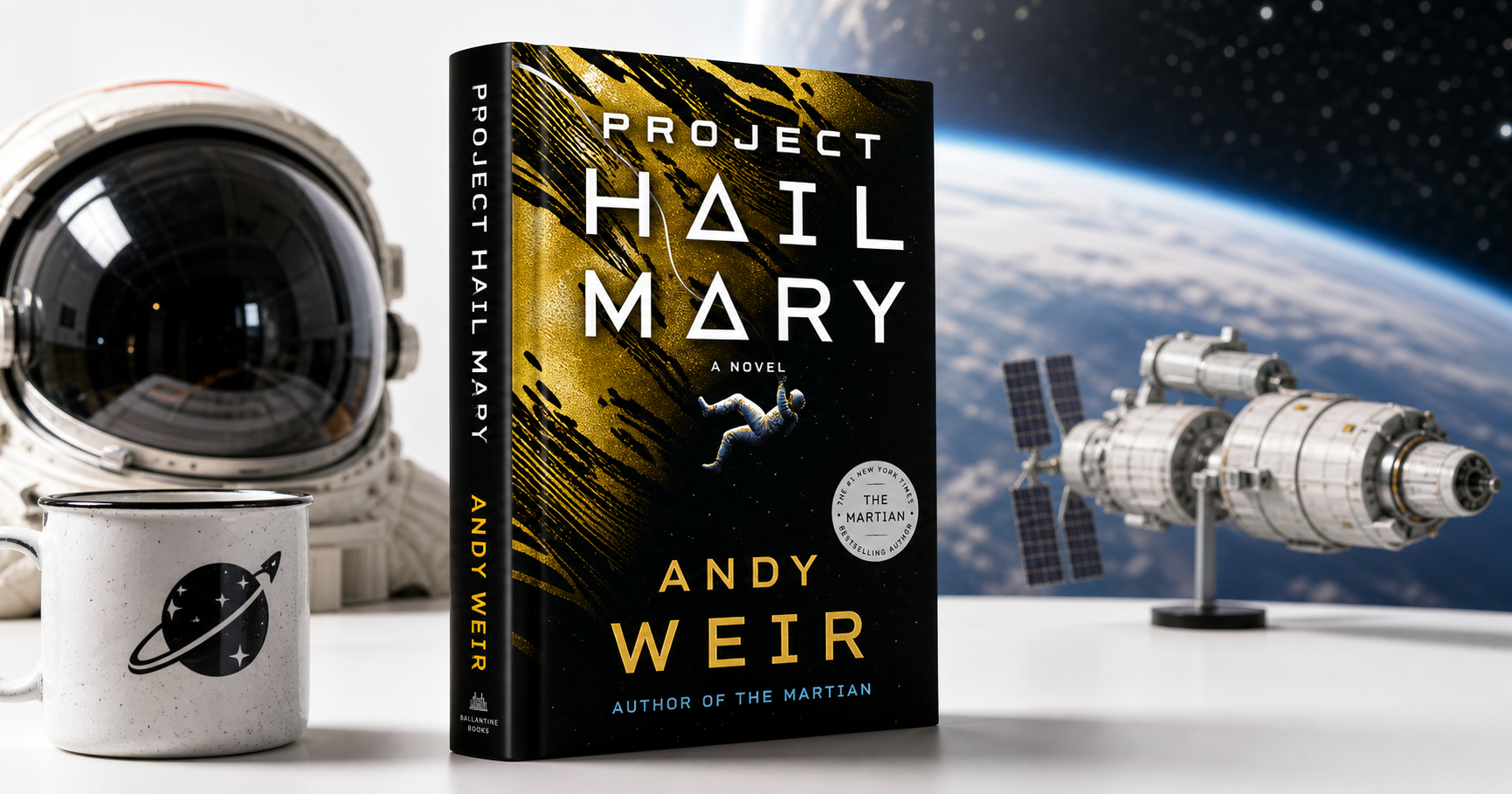
Project Hail Mary: A Novel is a standalone science-fiction thriller from Andy Weir, best known for The Martian. Like his earlier work, this book blends hard science with a high-stakes survival story. The protagonist, Ryland Grace, wakes up alone on a spacecraft with no memory of who he is or why he is there. As his memories return in fragments, he discovers he has been sent on a desperate mission to save humanity from an astrophysical threat.
The novel mixes mystery, problem-solving, and character-driven drama. Readers follow Grace as he pieces together his past through flashbacks while simultaneously tackling life-or-death engineering and scientific challenges aboard the ship. The tone alternates between tense, humorous, and surprisingly emotional, making it approachable even for readers who do not typically read hard science fiction.
From a value perspective, the book is positioned as a premium, mainstream sci‑fi release, and it is often available around $13.88 for the standard edition depending on format and retailer.
Standout Features
1. Science-Driven Storytelling
The most distinctive feature of Project Hail Mary is how deeply the plot is rooted in real or plausibly extrapolated science. Orbital mechanics, astrophysics, biology, and engineering are woven into the narrative. Problems are solved through experimentation, calculation, and iterative design rather than through hand-waving or convenient miracles.
Crucially, the science is not just flavor; it is the story. Every major turning point depends on understanding the constraints of physics or biology and then working within them. This will strongly appeal to readers who enjoy seeing realistic problem-solving on the page.
2. Dual Timeline Structure
The novel alternates between two main timelines:
- Present tense aboard the Hail Mary – Ryland Grace struggling with isolation, resource management, and the primary mission in deep space.
- Recovered memories on Earth – flashbacks that reveal how the mission was conceived, who was chosen to participate, and the political and ethical debates that shaped it.
This structure creates an unfolding mystery: readers learn about Grace’s past and the mission’s true nature at the same time he does. It keeps the narrative engaging and breaks up dense technical sections with character and world-building scenes.
3. First-Person, Conversational Voice
The story is told in first person, with Grace narrating in a casual, often self-deprecating style. This voice makes the heavy scientific content more digestible and gives the book a sense of immediacy. Jokes, asides, and internal monologues prevent the tone from becoming too bleak despite the apocalyptic stakes.
4. A Strong Emotional Core
Beyond the science and suspense, one of the book’s most memorable elements is its focus on cooperation and empathy. Midway through the story, the narrative pivots from pure survival to an exploration of communication, trust, and cross-cultural understanding (in a very literal, interspecies sense). This relationship becomes the emotional heart of the book and significantly raises the emotional stakes.
Supporting Features
1. Well-Defined Worldbuilding
The novel provides a clear sense of:
- Global response to crisis – how different nations collaborate and compromise when facing an existential threat.
- Mission logistics – training, ship design, crew selection, and the political trade-offs required to launch an unprecedented space mission.
- Scientific ecosystem – the interplay between academic research, government agencies, and industry when mobilized under severe time pressure.
These details are present without overwhelming the main plot, giving the story a grounded, near-future plausibility.
2. Puzzles and Problem-Solving Set Pieces
Fans of intellectual challenges will find many self-contained “problems” throughout the book: identifying unknown organisms, optimizing power systems, creating novel materials, and improvising repairs with limited tools. Each sequence is structured like a puzzle, with clearly stated constraints and a logical path to the solution.
3. Humor and Lightness
Despite the potentially grim premise, the novel maintains a consistent thread of humor. Grace’s commentary, occasional pop-culture references, and absurd scenarios provide levity. This makes the book more accessible to readers who might otherwise be put off by continuous technical exposition.
Usability
While “usability” usually applies to physical products or software, it can also describe how easy a book is to read and enjoy:
- Accessibility for non-scientists: The narrative does not assume a technical background. Most equations and calculations are sketched at a high level. When details are more complex, they are usually explained in plain language or broken into steps.
- Clarity of explanations: When the story introduces a new concept—such as a biological mechanism or orbital maneuver—it is typically framed around a practical problem and illustrated with a concrete example.
- Length and pacing: The book is substantial but not unwieldy. Chapters are relatively short, which makes it easy to read in increments. Frequent cliffhangers at chapter breaks encourage continued reading.
That said, readers who strongly prefer character drama over technical explanation may find some sections slower, especially during extended problem-solving sequences.
Performance
In the context of a novel, “performance” can be understood as how well it delivers on its genre promises and reader expectations:
1. As Hard Science Fiction
- Scientific rigor: The book tries to respect known physics and biology, only bending them where necessary to construct the central premise.
- Internal consistency: Once the universe’s rules are set, the story adheres to them. Solutions usually emerge from information already given to the reader, supporting a fair sense of puzzle-solving.
2. As a Thriller
- Tension: Life-support constraints, mission deadlines, and unknown variables in deep space provide continuous stakes.
- Escalation: Challenges scale logically: early issues are about basic survival; later ones involve more complex trade-offs and moral decisions.
3. As Character-Driven Fiction
- Protagonist depth: Ryland Grace’s personality, motivations, and vulnerabilities become clearer as memories return. His background as a teacher and scientist meaningfully shapes his decisions.
- Relationships: The central relationship that develops in space adds warmth and humor, and it drives some of the novel’s most impactful scenes.
Overall, the book performs strongly across its hybrid goals: it reads as both a page-turning adventure and a celebration of methodical, science-based thinking.
Pros and Cons
Pros
- Engaging hard sci-fi: Deeply integrates real or plausible science into every layer of the plot.
- Compelling mystery structure: The dual timeline and memory-loss setup sustain curiosity throughout.
- Relatable narrative voice: First-person, conversational style keeps dense material approachable.
- Emotional resonance: Themes of cooperation, sacrifice, and cross-cultural understanding give the story heart.
- Clear, logical problem-solving: Readers who like puzzles and engineering challenges will find many satisfying sequences.
- Standalone story: No prior reading or series commitment required.
Cons
- Heavy on technical detail: Readers not interested in scientific explanations may find portions of the book slow or overly detailed.
- Tone may feel familiar to Weir’s previous fans: The voice and structure share similarities with The Martian, which may feel repetitive to some.
- Limited focus on broader cast: Secondary characters outside the central relationship are less developed, especially those on Earth.
- Occasional pacing dips: Extended engineering or calculation segments can temporarily reduce narrative momentum for some readers.
Summary
Project Hail Mary: A Novel is a well-executed blend of hard science fiction, survival thriller, and heartfelt character story. It showcases Andy Weir’s strengths: clear scientific exposition, inventive problem-solving, and an affable narrative voice that makes complex topics accessible.
Readers who enjoyed The Martian, or who generally appreciate science-forward, puzzle-rich storytelling, are likely to find this novel highly rewarding. Those seeking purely character-focused drama with minimal technical content may have a more mixed experience, but can still appreciate the emotional core and themes of cooperation and ingenuity.
If you are interested in a modern sci-fi novel that celebrates curiosity, collaboration, and the power of methodical thinking under extreme pressure, Project Hail Mary is a strong candidate—especially when you can find it around $13.88 depending on format and retailer.