
RockJam 61-Key Keyboard Piano Kit with Pitch Bend: A Complete Beginner Bundle Reviewed
Product Summary
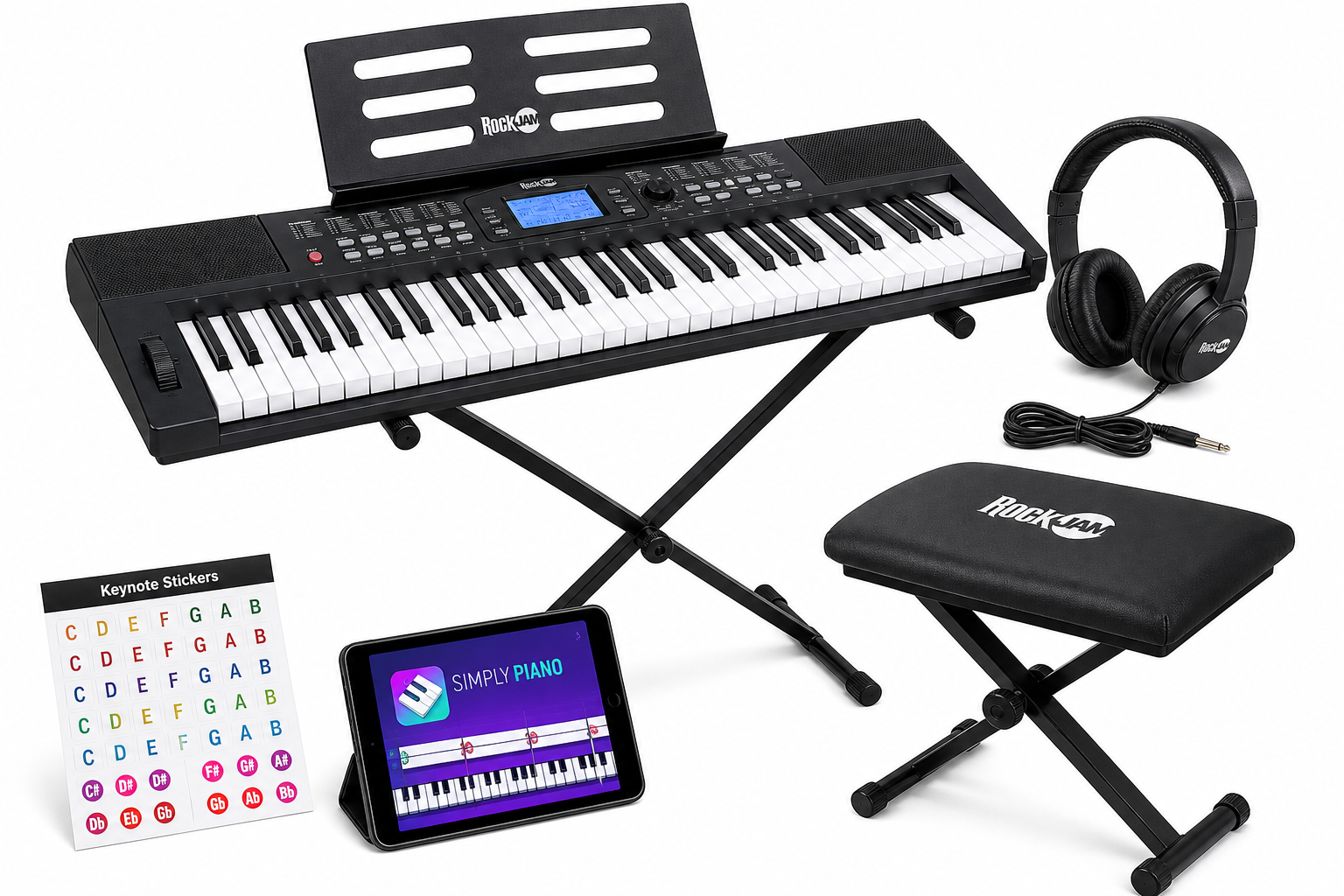
The RockJam 61 Key Keyboard Piano Stand With Pitch Bend Kit, Piano Bench, Headphones, Simply Piano App & Keynote Stickers (often referred to by its model code RJ5061) is an all‑in‑one starter pack designed to get new players up and running quickly.
You get:
- A 61‑key electronic keyboard with pitch‑bend wheel
- Adjustable X‑style keyboard stand
- Foldable, padded keyboard bench
- Closed‑back headphones
- Music rest / sheet‑music stand
- Keynote stickers for labeling notes on the keys
- Access to app‑based lessons (including Simply Piano‑compatible content)
The keyboard itself offers a wide sound palette and built‑in learning aids, while the included hardware and stickers remove much of the friction of setting up a first instrument at home.
From a value perspective, this bundle is typically positioned at the entry‑level end of the market, with street pricing often around $129.99 or less during promotions, making it accessible for parents and adult beginners who want a low‑commitment starting point.
Target Users
This kit is best suited to:
- Children and young beginners who are trying piano or keyboard for the first time
- Adult hobbyists who want an inexpensive way to explore playing chords, melodies, or pop songs
- Casual players who mainly want to jam along with backing tracks or experiment with different sounds
- Households on a budget that need a complete setup (stand, bench, headphones) without piecing together separate components
It is not the ideal choice for:
- Intermediate or advanced pianists seeking realistic piano feel
- Serious learners planning to progress to graded piano exams
- Players who specifically need weighted or hammer‑action keys and high‑quality acoustic‑piano samples
For many first‑time users, however, the RockJam package delivers the key essentials to test the waters.
Main Benefits
1. Complete, Ready‑to‑Play Package
One of the strongest advantages is that this is a turnkey kit. You don’t need to source a separate stand, bench, or headphones, and the included keynote stickers shorten the learning curve for absolute beginners.
2. 61 Keys with Pitch Bend and Wide Sound Palette
The keyboard offers:
- 61 keys (five octaves), covering most beginner and pop repertoire
- A pitch‑bend wheel, uncommon at this price level, allowing expressive slide effects
- A large selection of built‑in tones (voices) such as pianos, electric pianos, organs, strings, synths, and more
- Backing rhythms and demo songs suitable for practice and play‑along
This combination makes it fun to explore a variety of musical styles without additional equipment.
3. Built‑In Learning Functions
The RockJam keyboard includes:
- Step‑by‑step lesson modes on the onboard display
- Demo songs that can be broken down and practiced section by section
- Keynote stickers that visually map the names of the notes
- Compatibility with smartphones or tablets for use with lesson apps such as Simply Piano or other third‑party learning platforms
For visual learners and younger students, these aids can make the first few weeks of practice more engaging.
4. Headphone Output for Quiet Practice
With a dedicated headphone jack and included over‑ear headphones, students can practice quietly without disturbing others, which is a major benefit in apartments, shared spaces, or late‑night practice scenarios.
5. Compact and Portable
Compared with an 88‑key digital piano, this 61‑key model is relatively light and easy to move. The collapsible X‑stand and folding bench make storage straightforward when space is limited.
Key Considerations
Despite its strengths as a starter bundle, there are several important trade‑offs to understand before buying.
1. Non‑Weighted, Light Key Action
The keys are not weighted and do not mimic the feel of an acoustic or hammer‑action digital piano. They are relatively light and can feel “springy.” This is acceptable for casual playing, but:
- Technique developed on this keyboard may not fully translate to a real piano
- Dynamics (playing softly vs. loudly) are less nuanced than on a touch‑sensitive or fully weighted instrument
If your long‑term goal is classical or serious piano study, you may outgrow the feel fairly quickly.
2. Build Quality and Durability
The overall construction is typical of an entry‑level keyboard:
- The chassis and stand are mostly lightweight metal and plastic
- Some users report that the keys can feel slightly wobbly side‑to‑side
- The X‑stand is sturdy enough for children and sitting play, but may wobble if heavily leaned on
It is generally suitable for home practice, but less ideal for frequent gigging or rough transport.
3. Sound Quality and Speakers
The built‑in speakers are adequate for bedroom practice and small rooms, but they are not designed for performance‑level volume or audiophile‑grade sound. The acoustic piano tones are serviceable for beginners, while many of the extra voices are more about fun and experimentation than realism.
4. Limited Upgrade Path
Because the core feel and sound engine are entry‑level, this is not a keyboard you are likely to keep as your primary instrument once your skills and ear advance significantly. Many users treat it as a stepping‑stone before moving to a more advanced digital piano or synthesizer.
5. App Lessons vs. Traditional Instruction
The inclusion of app‑compatible lessons is a major draw, but effectiveness will depend on:
- The learner’s discipline and consistency
- Whether you complement the app with technique guidance (from videos, books, or a teacher)
App‑only learning can work for some, but others will benefit from at least occasional input from a human instructor.
Pros
- All‑in‑one bundle: keyboard, stand, bench, headphones, stickers, and lesson access in a single package
- Budget‑friendly starting point, with typical pricing in the $129.99 range depending on sales
- Pitch‑bend wheel adds expressive possibilities uncommon in this price bracket
- Variety of sounds and rhythms, making practice more playful and keeping children engaged
- Headphone output for silent practice and less disturbance to others
- Compact and portable, with foldable stand and bench suitable for small spaces
- Keynote stickers and lesson functions lower the barrier to entry for absolute beginners
- Simple setup: mostly plug‑and‑play with easy stand and bench assembly
Cons
- Non‑weighted, light action keys that do not closely resemble an acoustic piano
- Speaker quality and volume are just adequate for home use; not suited for performance without external amplification
- Plastic build and wobbly key feel can make the instrument feel toy‑like to more experienced players
- Limited long‑term growth for serious students; you may need to upgrade within 1–2 years if practice is consistent
- Stand stability is fine for seated use, but not ideal for heavy playing or frequent adjustment
- The 61‑key range, while sufficient for most beginner material, does not cover the full 88‑key piano repertoire
Alternatives
If you are considering the RockJam kit, it can be useful to compare it to a few alternative directions conceptually:
-
Similar 61‑Key Beginner Bundles
Other brands offer 61‑key packages with stands and headphones at a similar or slightly higher price point. These often provide broadly comparable features: multiple voices, rhythms, and lightweight construction. RockJam’s main edge is typically aggressive pricing and widespread availability. -
61‑Key Keyboards Without Full Bundle
If you already own a sturdy table or chair, you might consider a bare 61‑key keyboard from a more established digital‑piano brand and add accessories later. This can sometimes yield better key feel and sound quality at a similar total spend, although the upfront kit is less convenient. -
Entry‑Level 88‑Key Digital Pianos
For serious learners focused on piano rather than general keyboard playing, an 88‑key digital piano with weighted or semi‑weighted keys is a stronger long‑term investment. It typically costs more than $129.99, and you may need to add a stand and bench separately, but the playing experience is far closer to a real piano. -
Used Digital Pianos
In some markets, you may find used 88‑key digital pianos near or just above the RockJam’s typical new price. This path can provide better feel and sound, though without the simplicity and warranty of a brand‑new kit.
When choosing between these paths, think about how committed the player is, the space available, and your budget tolerance for an instrument that may need upgrading later.
Conclusion
The RockJam 61 Key Keyboard Piano Stand With Pitch Bend Kit is a practical, budget‑conscious choice for families and individuals who want a complete starter setup with minimal hassle. Its combination of a 61‑key keyboard, pitch bend, multiple sounds and rhythms, bundled stand and bench, headphones, stickers, and app‑compatible lessons makes it appealing for first‑time players—especially children—who are exploring music for fun.
Its main compromises lie in the non‑weighted, light key action, modest speaker quality, and overall entry‑level build. For casual use, trying out piano as a hobby, or giving a child an accessible first instrument, these trade‑offs are often acceptable, particularly at a typical street price around $129.99. However, if you anticipate sustained, serious study or want an experience closer to an acoustic piano, it is worth considering an 88‑key weighted digital piano instead.
In short, the RockJam 61‑key kit is best viewed as a first step: affordable, convenient, and feature‑rich enough to reveal whether the player’s interest in music will grow—at which point, upgrading to a more advanced instrument will make clear sense.